
Our House in Ghent
Historian Wim Bot is a prominent expert of the Dutch Cyclists’ Union (Fietsersbond). He is also known as the ‘football professor’ of Feyenoord, the big club of the port city of Rotterdam. In this contribution to Favas.net, he delves into the history of the labour movement. In Ghent, Belgium, he visited two historic buildings that housed this movement. He reflects on this history with nostalgia and longing, but concludes with a hopeful outlook on the future. Hope for a better world from old socialists to young climate activists.
Our House in Ghent, a socialist monument – About melancholy, longing and hope
By Wim Bot (November 2025)
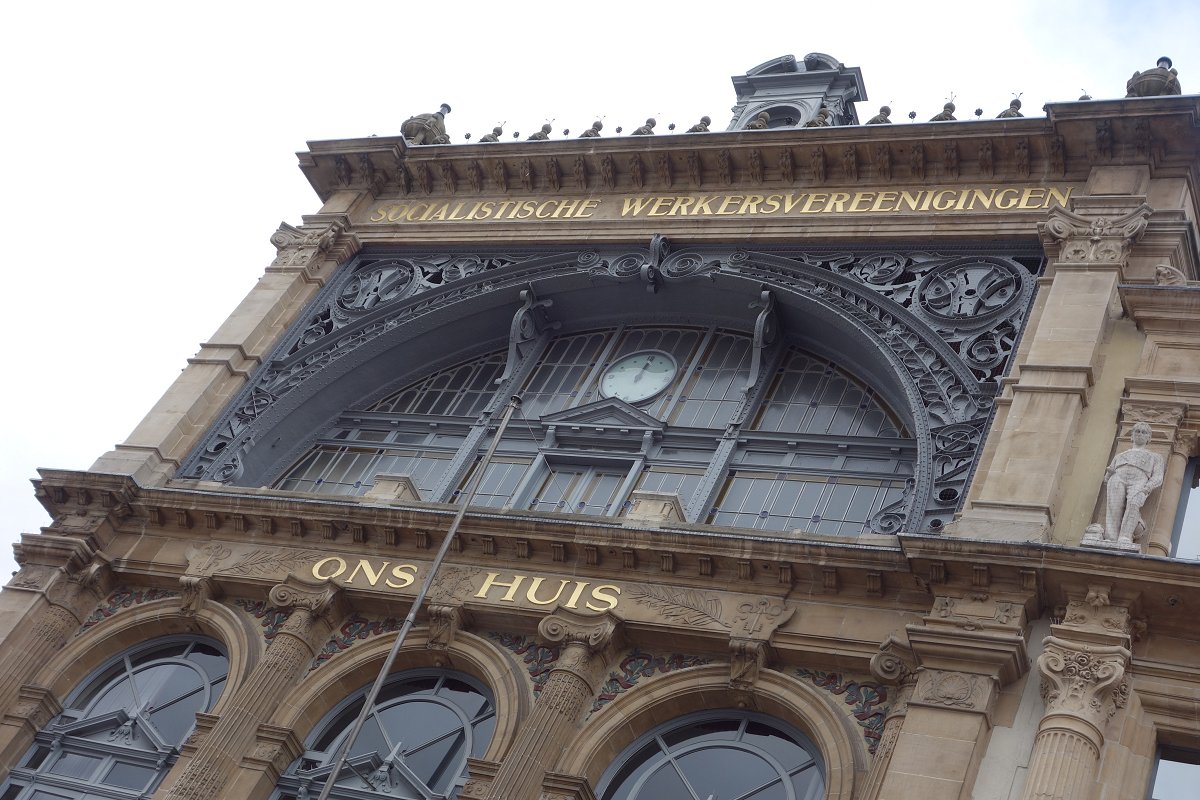
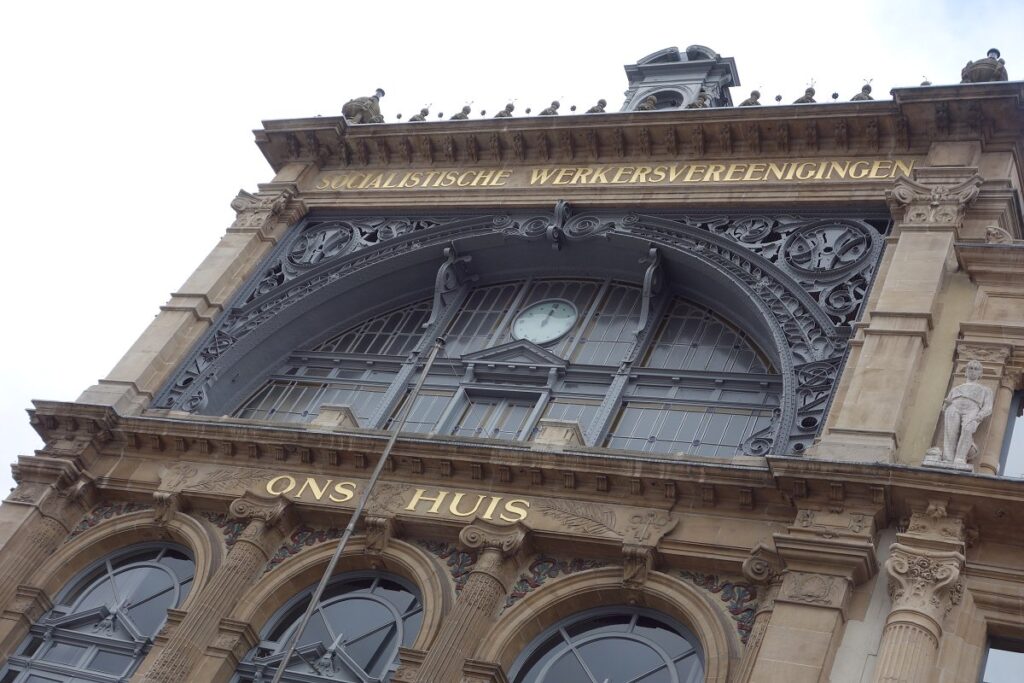
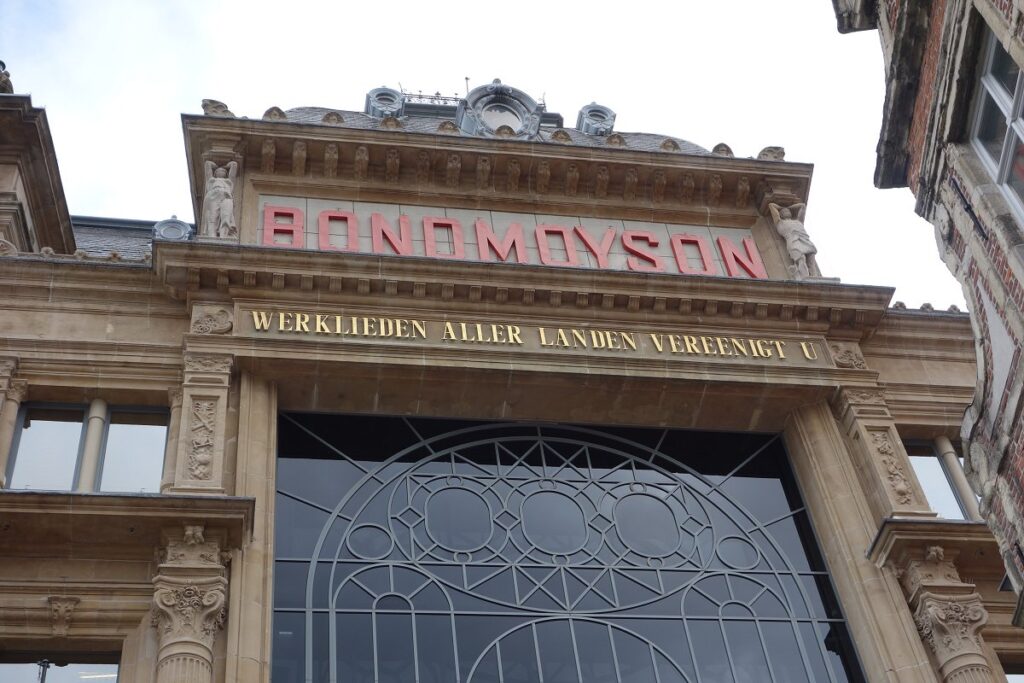
On Ghent’s beautiful Vrijdagmarkt square, two buildings dominate, forming a single structure: Our House (Ons Huis) and Moyson Union (Bond Moyson). The facade above Our House bears the inscription ‘Socialist Workers’ Associations’ (Socialistische Werkersveerenigingen). The other facade bears the famous slogan from Marx and Engels’s 1848 Communist Manifesto: ‘Workers of the World Unite’ (Werklieden aller landen vereenigt u). Amsterdam (Netherlands) owns the famous Diamond Workers’ Union Castle of architect Berlage, but this Ghent structure is grander, a true monument to the socialist labour movement of the late nineteenth century. I couldn’t think of a comparable building.
The building’s location in Ghent is no coincidence. Ghent has a rebellious history, characterized by crafts and later industrial industry, complete with guilds and early trade unions. Some of this history can be seen in the local Industrial Museum, which is filled with old looms and printing presses. Anyone wishing to know what life was like for workers around the turn of the last century should read the first part of ‘War and Turpentine’ by Stefan Hertmans, which brings to life the inferno of the iron foundry where his grandfather worked. In the second half of the 19th century, Ghent was ‘the most proletarian city and the cradle of the modern labour movement’ in Flanders.
In 1893, the Vooruit cooperative purchased two buildings, which were converted into a department store. After a fire in 1897, the buildings were rebuilt. Socialist cooperative leader Eduard Anseele commissioned the young architect Ferdinand Dierkens to design a new building, inspired by the Parisian Grands Magasins. The large Art Nouveau window on the right-hand side is impressive. Jules de Bleye was commissioned to decorate the facades with socialist allegorical scenes. The building served as a meeting and gathering place for the socialist movement, literally ‘Our House’.
Money was not a consideration; for ‘the working people’ (”t arbeidende volk’), only ‘the best, the most beautiful’ (‘het beste, het schoonste’) was good enough, according to the Belgian Workers’ Party newspaper Vooruit. The ‘proud architectural order, splendor, and grandeur’ (‘fiere bouworde, pracht en grootschheid’) of the ‘two central buildings’ were said to “continue to point to the ever-increasing demand of the proletariat for a better, nobler existence; for the enjoyment of art and the luxury of life!’(‘steeds wijzen op de immer hooger stijgende eisch van het proletariaat naar een beter, edeler bestaan; naar kunstgenot en levensweelde!’) Our House currently houses the ABVV trade union and Bond Moyson, now the Solidaris health insurance fund. In 1913, another socialist monument opened in Ghent, also designed by Dierkens: the Vooruit Festival Hall, now known as the VIERNULVIER Arts Centre.
I took a tour during one of the annual Open Monument Days in Flanders. The building has been renovated several times. Some sections are insignificant office spaces, but other rooms remain in their original state and in all their glory. The meeting room has a beautiful table, pink Art Deco armchairs, and wood panelling. In the large café area, with a lovely view of the square, hang beautiful pre-World War II posters and an impressive painting of industrial workers.
Standing before the building, I was overcome with a sense of melancholy. How great was the emerging labour movement of the late nineteenth and early twentieth century. A movement that achieved so much, such as universal suffrage, a higher standard of living, and social security. But also a movement that has become completely integrated into the capitalist system, lacking a vision for the future and lacking inspiration, a movement that has lost a large portion of the old working-class electorate.
In a bygone spring (2024) I read the impressive book ‘Under A Different Sky: About Homesickness and Narrative Pain’ by Joke Hermsen. She writes (our translation from the original Dutch version): ‘Our lives unfold between homesickness for the familiar and a longing for the unknown. We want to feel secure and we dream of somewhere else.’ She quotes the German Jewish thinker Ernst Boch and his ‘Das Prinzip Hoffnung’ (‘The Passion of Hope Broadens People Instead of Narrowing Themselves’). Hermsen writes (again our translation): ‘The most important function of hope, according to Bloch, is that it enables us to criticize what already exists and not to be satisfied with the current world.’ I also recognize the same combination of melancholy, longing, and hope in the impressive work of the Italian Marxist historian Enzo Traverso.
The old socialism and the old labour movement are not coming back; that old house is gone. Meanwhile, Europe is increasingly dominated by the radical right and xenophobia, a genocide is taking place in Gaza with the complicity of the West, and we don’t know how the war in Ukraine will end. What remains is the hope, the optimism of the will and desire of all those people who want a better world, a better home, Our House, from old socialists to young climate activists.
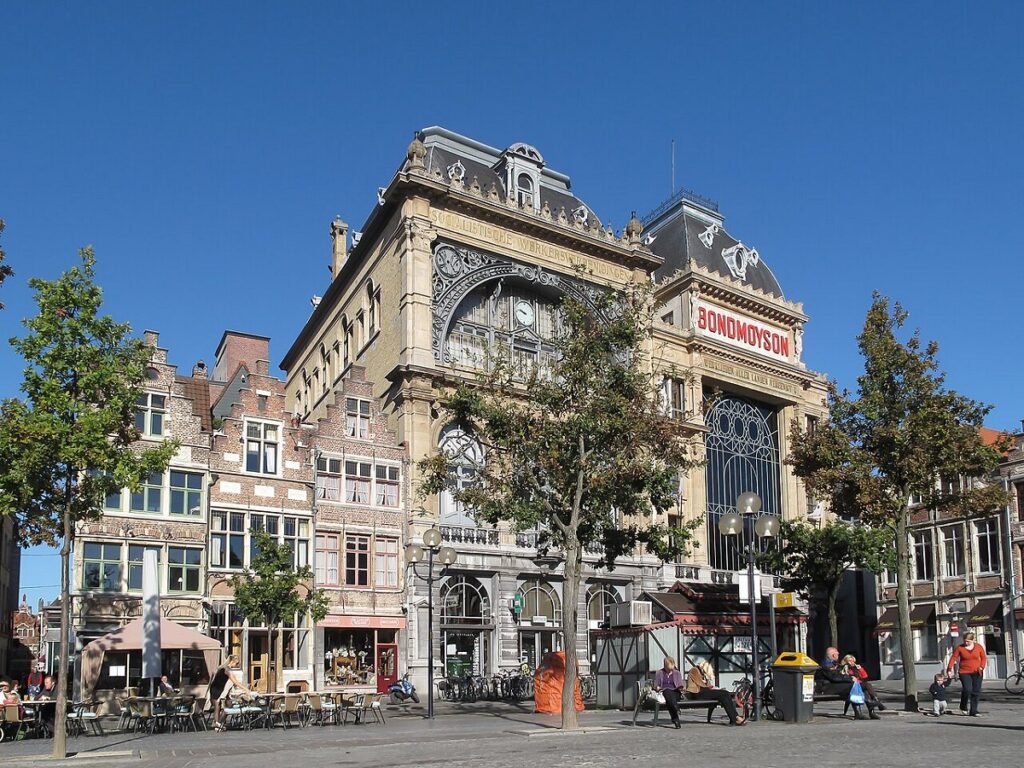
Ghent, Vrijdagmarkt – the two buildings: ‘Ons Huis’ and ‘Bond Moyson’.
Photo by Michiel Verbeek (3.0 Unported).
Text: Wim Bot
Translation & editing: Favas.net
Images: Michiel Verbeek & Favas.net
Hope for a better world from old socialists to young climate activists. This report was published earlier in Dutch on ‘Linksbuiten’ Wimbot.blogspot.com/ (September 14, 2024).
Other reports of Wim Bot at Favas.net:
Roaring the Red Front – About collective and non-discriminatory football culture.
And more to come …
COMMENTS
Mail Favas.net editor: robvanderbijl@favas.net